Take urgent action to combat climate change and its impacts.
Canada is among the most rapidly warming regions on Earth. Wilfrid Laurier University is embracing this complex challenge and working to be part of the solution. Through leading research and academic programs and operational practices, Laurier is demonstrating our strong commitment to SDG 13.
The work that Laurier completed in 2025 to advance SDG 13.
Polar Knowledge Canada is pleased to announce the recipient of the 2025 Northern Science Award. This prestigious award is presented annually to an individual or team who have made a significant contribution to advancing knowledge and understanding of the Canadian North. Dr. Homa Kheyrollah Pour, Ph.D. was presented with the award and Centenary Medal at the ArcticNet Annual Scientific Meeting gala in Calgary, Alberta, on December 18, 2025.
Nikolai Cook, an assistant professor of Economics at Wilfrid Laurier University’s Lazaridis School of Business and Economics, has been awarded the 2024 John Charles Polanyi Prize in Economic Science by the Government of Ontario. The annual awards celebrate five early career scholars who are making significant contributions in the fields of chemistry, economic science, literature, physics and medicine.
“This is a once-in-a-lifetime honour for a young researcher,” says Cook. “I am absolutely humbled. It is validation and motivation for me to continue my research.”
In the environmental realm, Cook studies the effects of climate change and air pollution on economic outcomes.
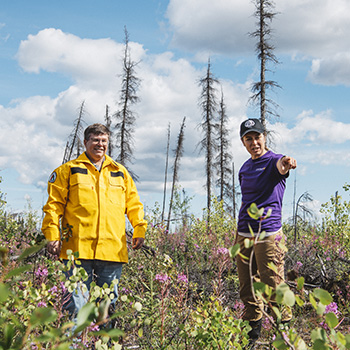
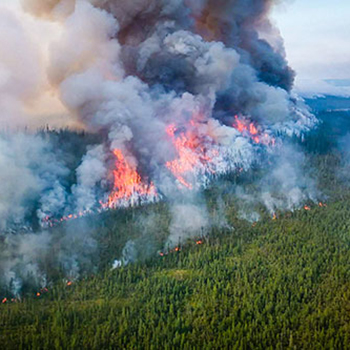
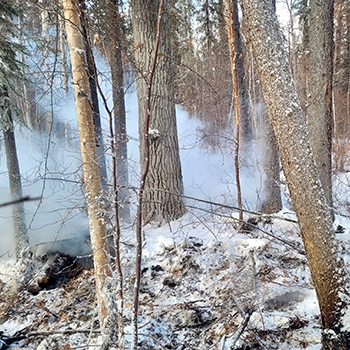
A new study from Wilfrid Laurier University offers a rare “good news story” in relation to forest fires. Jennifer Baltzer, the Canada Research Chair in Forests and Global Change, published the first-ever field data on overwintering fires – also known as “zombie” fires – which continue to smoulder throughout the winter and reignite the following spring. Despite fears that zombie fires would increase carbon release and hinder forest regrowth, Baltzer’s data suggests that they are less destructive than anticipated.
Is Canada Day getting warmer? That’s a question three student researchers from Wilfrid Laurier University set out to answer by analyzing 75 years of temperature data in 14 capital cities across Canada, using July 1 as a reference point. Their report shows a clear warming trend, with average temperature increases between 0.9 and 3.5 degrees Celsius since 1949.
Laurier research centres advancing SDG 13.
The Laurier Centre for Sustainable Food Systems (LCSFS) connects researchers and community partners engaged in sustainable food systems change. It creates opportunities for citizens, practitioners, policy-makers, private enterprise and academics to work together to imagine and foster food systems that are fair, healthy, ecologically regenerative, culturally appropriate, prosperous and inclusive. Using food as a lever for positive change, the LCSFS enables meaningful collaboration among people across institutions, sectors and disciplines to support community-driven research, innovative knowledge sharing, and the development of community resources and sustainable food system policy.
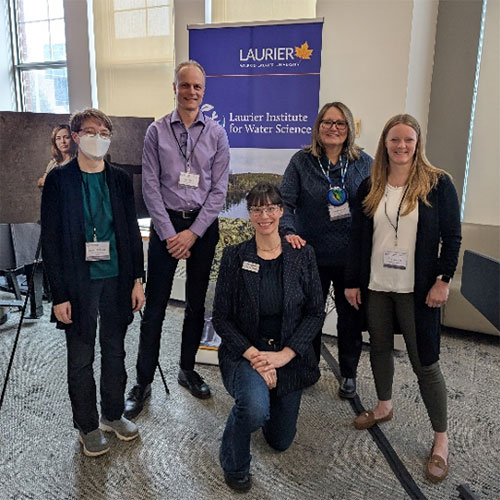
The Laurier Institute for Water Science is a multidisciplinary, collaborative undertaking among research faculty in the Faculty of Arts, the Lazaridis School of Business and Economics and the Faculty of Science. The focus of the institute is on research in three interconnected water-related disciplines:
The Cold Regions Research Centre was established in 1987. Initially focused on arctic and mountain glaciology and hydrology, the scope has broadened to cold regions (mountain and northern) research consulting on topics such as hydrology, climatology, glaciology, resource management, parks planning and biogeochemistry.
The Viessmann Centre for Engagement and Research in Sustainability (VERiS) is an interdisciplinary and community-engaged research centre striving to be a catalyst and nexus for the transition toward strong cultures of sustainability. The centre understands cultures of sustainability “as characterized by shared values, symbols, rituals and practices grounded in sustainability principles leading to individual and societal choices that promote environmental protection, social justice and well-being, and a supportive economy." A culture of sustainability may exist within an organization, a building with multiple organizations or a community.
Laurier initiatives in 2025 that advanced SDG 13.
Using 2009 as the baseline year for emissions inventory, Laurier measures low carbon energy by:
Laurier's success in adopting clean and renewable electricity through the Laurier Energy Efficiency Program (LEEP) from 2016 to 2022 represents a significant milestone in its sustainability journey. LEEP, a $48-million multi-phase initiative, has transformed Laurier’s building portfolio into a benchmark for sustainable management. Key components of this program include the installation of rooftop solar panels, battery storage systems and a fully operational microgrid that enhances the energy resilience of the Waterloo campus.
The program’s success is reflected in the implementation of diverse energy conservation measures across Laurier’s campuses. These include the installation of two solar walls at the Waterloo campus’s library and Bricker residence, which have effectively reduced energy consumption during the heating season. More than 1,500 solar panels were installed on seven buildings on the Waterloo and Brantford campuses, generating enough clean electricity each month to power approximately 820 laptops. In 2023-24, these seven installations across the Clara Conrad, Grand River Hall, Lazardis Hall, Library, Peters and Science buildings equate to 446.2 MW of clean energy generated and consumed.
Laurier participates in and provides a range of local education programs. Examples include:
Laurier's Climate Action Plan is formally presented in its 2023-2028 Laurier Sustainability Action Plan. The Plan outlines how the institution is supporting meaningful action on climate change. Actions include:
To further cement our commitment to addressing climate change, Laurier is among 20 Canadian universities pledging to help address climate change through the “Investing to Address Climate Change: A Charter for Canadian Universities”. This charter calls for universities to:
Since 2010, Laurier has maintained a unique and productive research partnership with the Government of the Northwest Territories (GNWT). The partnership, which was expanded and extended to 2030, has brought new research expertise and training opportunities to the NWT and strong community connections and research opportunities to Laurier scholars. Much of this collaborative work addresses the SDGs. Close connections between academic researchers and government enhance policy development related to the SDGs and improve the capacity of government to engage in adaptive management. Laurier collaborates with partners at the regional, territorial level and on the local community level to plan for climate change disasters include forest fire, flooding, drought and permafrost thaw. Learn more about the Laurier-GNWT partnership and its areas of research.
Laurier is also home to the Viessmann Centre for Engagement and Research in Sustainability (VERiS) , an interdisciplinary research Centre. As an increasing number of municipalities are declaring climate emergencies and developing comprehensive climate action plans, efforts to mitigate climate change can unintentionally create social inequities within communities. Researchers at VERiS are partnering with partners, including municipalities and NGOs across Canada, and internationally, to co-operatively plan for climate change disasters. The group seeks to identify, develop and test innovative and practical approaches to addressing climate change in a manner that helps ensure and address equality.
Laurier is committed to creating and advancing partnerships with non-governmental organizations (NGOs) in our greater community to advance climate adaptation. By combining academic expertise with practical experience and community engagement, these collaborations can develop innovative, evidence-based solutions that address the multifaceted challenges of climate change. Such partnerships not only enhance the capacity of both institutions, but also lead to more sustainable and impactful climate adaptation strategies. Some of Laurier's recent partnerships with NGOs include:
As outlined in its Sustainability Action Plan, Laurier is committed to reaching a greenhouse emissions reduction mandate of 40% by 2030 and carbon neutrality across Scope 1, 2 and 3 by 2050.
Discover how Laurier is contributing to United Nations Sustainable Development Goal targets.