Conserve and sustainably use the oceans, seas and marine resources for sustainable development.
Wilfrid Laurier University is a leader in water research and academic programming. In alignment with SDG 14, we actively engage in work to protect aquatic ecosystems from human activity and climate change-related impacts.
The work that Laurier completed in 2025 to advance SDG 14.
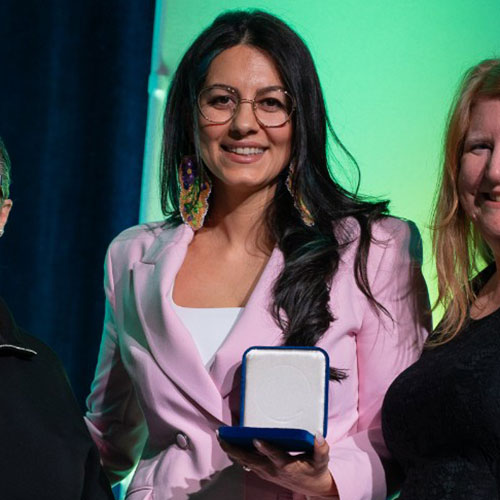
Dr. Joseph Culp was annouced as the recipient of the distinguished recipient of the 2025 Hynes Lecture award, one of the most prestigious honours in the field of freshwater science.
Named in memory of H.B. Noel Hynes, a pioneering figure in limnology and stream ecology, the Hynes Lecture recognizes individuals whose contributions have significantly advanced the understanding of freshwater systems. Each year, this award celebrates a scientist whose work embodies the spirit of curiosity, innovation, and dedication that defined Dr. Hynes’s legacy.
When the Aquatic Science Outreach Network for the Grand (AquaSONG) Project began in 2014, Wilfrid Laurier University scientists took 25 high school students to the Grand River to learn about their local water body. A decade later, between 500 and 700 grade 10 and 11 students from Waterloo Region participate in AquaSONG every year. In the words of one local teacher, it was “the best field trip I’ve ever taken my students on.”
Laurier research centres advancing SDG 14.
The Laurier Institute for Water Science is a multidisciplinary, collaborative undertaking among research faculty in the Faculty of Arts, the Lazaridis School of Business and Economics and the Faculty of Science. The focus of the institute is on research in three interconnected water-related disciplines:
The Cold Regions Research Centre was established in 1987. Initially focused on arctic and mountain glaciology and hydrology, the scope has broadened to cold regions (mountain and northern) research consulting on topics such as hydrology, climatology, glaciology, resource management, parks planning and biogeochemistry.
Laurier initiatives in 2025 that advanced SDG 14.
Since 2010, Laurier has maintained a unique and productive research partnership with the Government of the Northwest Territories (GNWT). The partnership, which has been expanded and extended to 2030, has brought new research expertise and training opportunities to the Northwest Territories (NWT) and strong community connections and research opportunities to Laurier scholars. Much of the work through Laurier's partnership with the GNWT addresses the SDGs. Close connections between academic researchers and government enhance policy development related to the SDGs and improve the capacity of government to engage in adaptive management.
The Aquatic Science Outreach Network for the Grand (AquaSONG) is an NSERC-funded program coordinated by Laurier and the Centre for Cold Regions and Water Science. The primary purpose of this field trip is to inform and educate local high school students on the fragility of this local water body, encourage creative collaboration in a laboratory setting, teach basic field sampling techniques and demonstrate methods of analysis. The experience is centred around the concepts of wastewater treatment and analysis, and freshwater aquatic biology.
Hosted by the University of Saskatchewan, Global Water Futures (GWF) is a pan-Canadian research program that is funded in part by a $77.8-million grant from the Canada First Research Excellence Fund. Laurier is a core partner in GWF. The overarching goal of the program is to deliver risk management solutions informed by leading-edge water science and supported by innovative decision-making tools to manage water futures in Canada and other cold regions where global warming is changing landscapes, ecosystems and the water environment. GWF aims to position Canada as a global leader in water science for cold regions and will address the strategic needs of the Canadian economy in adapting to change and managing risks of uncertain water futures and extreme events.
Northern Water Futures is a NWT-focused consortium of knowledge producers, mobilizers and users from communities, government, industry, non-governmental organizations and universities, working collaboratively to understand, predict and address the impacts of climate change and industrial expansion on shared water resources across the NWT.
Discover how Laurier is contributing to United Nations Sustainable Development Goal targets.