Oct. 7, 2026
When Yash Goswami arrived in Brantford to begin his studies at Wilfrid Laurier University, public transit quickly became part of his daily routine. As a regular at the Brantford Transit Bus Terminal, conveniently located just across the street from his classes in Laurier’s Market Darling Centre, he soon gained firsthand insight into how riders navigate the city’s transit system.
“Taking Brantford Transit can sometimes be challenging, particularly if you’re unfamiliar with the system,” says Goswami. “The ticket desk isn’t always staffed, and when I first moved here, there was no screen displaying real-time bus information. For newcomers especially, having clear, up-to-date information can make a big difference in how confidently they use the system.”
These challenges could easily just end up as complaints to City Hall. Instead, for Goswami, along with fellow User Experience Design Master’s students Swarali Gogate, Carol Chen, Congxi Dong and Zhesheng Teng, they were a problem to be solved; the catalyst for a project that started in the classroom and culminated with an international design award win.
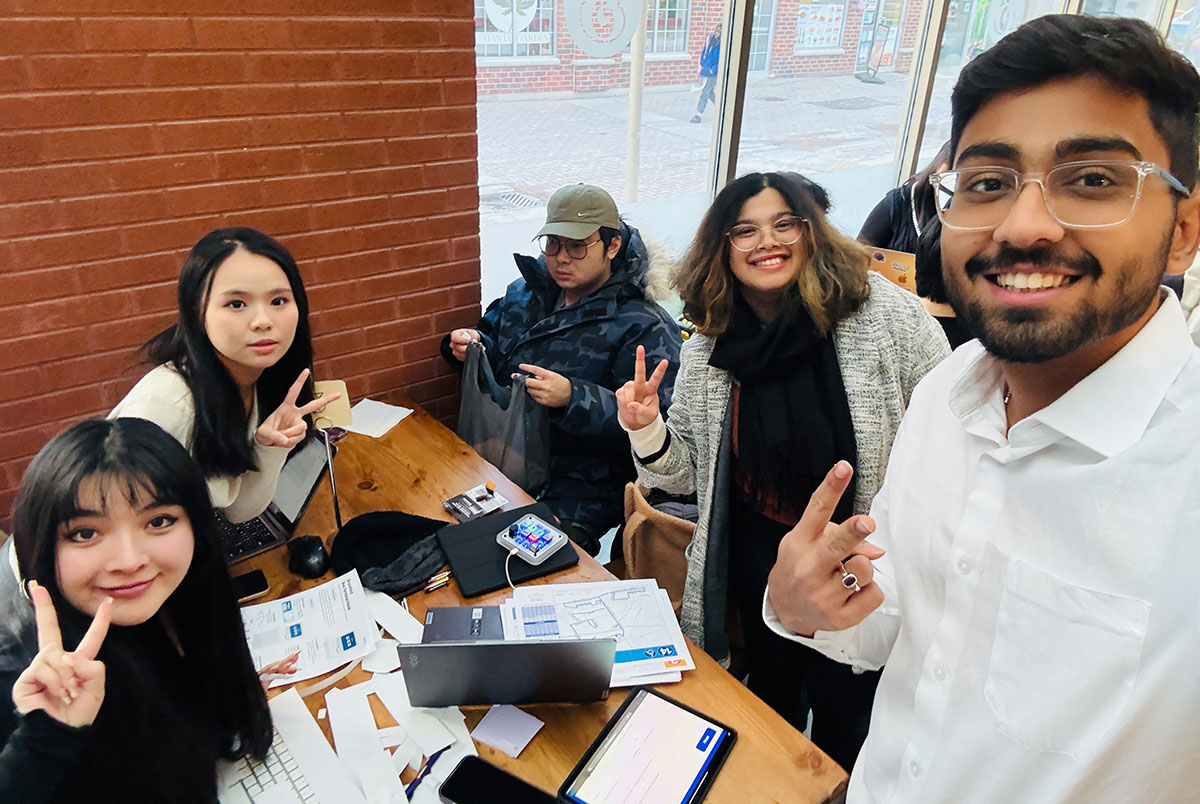
(From left) Congxi Dong, Carol Chen, Zhesheng Teng, Swarali Gogate and Yash Goswami are pursuing a Master of Science in User Experience Design at Laurier’s Brantford campus.
The students’ idea for the Brantford Bus Information Kiosk took shape in UX600: Human Centred Design, a course taught by Assistant Professor John Muñoz. Developed in collaboration with the Workforce Planning Board of Grand Erie, the course’s term project challenged teams of students to design a civic initiative in downtown Brantford using the six core principles of the ICF Canada Smart City framework. Despite the project’s fairly broad parameters, the team of Goswami, Gogate, Chen, Dong and Teng immediately set their sights on public transportation.
“All of us are international students and we rely heavily on public transit,” says Gogate, who took a leadership role on the project. “We quickly discovered that we weren’t alone in having issues navigating the transit system here.”

“Feeling confident using public transportation gives you the independence to explore a new city, a new province, a new country.”
Swarali Gogate, User Experience Design Master’s student
Their research findings highlighted opportunities to make the transit system more accessible and easier to navigate. Riders reported challenges keeping up with route changes that occur every few months, relying on printed schedules posted at the terminal and interpreting route names that use the same letter designation despite serving different destinations. Not only was there a significant language barrier experienced by newcomers to the city, there was also a pronounced digital divide, with one in five riders unable to access real-time bus information because they don’t use smartphones.
“When services migrate entirely to digital platforms, people who can’t afford internet and phones or aren’t tech-savvy lose access,” says Gogate. “Even if you can access the app on your phone, forgetting your charger could still leave you stranded at the end of the day.”
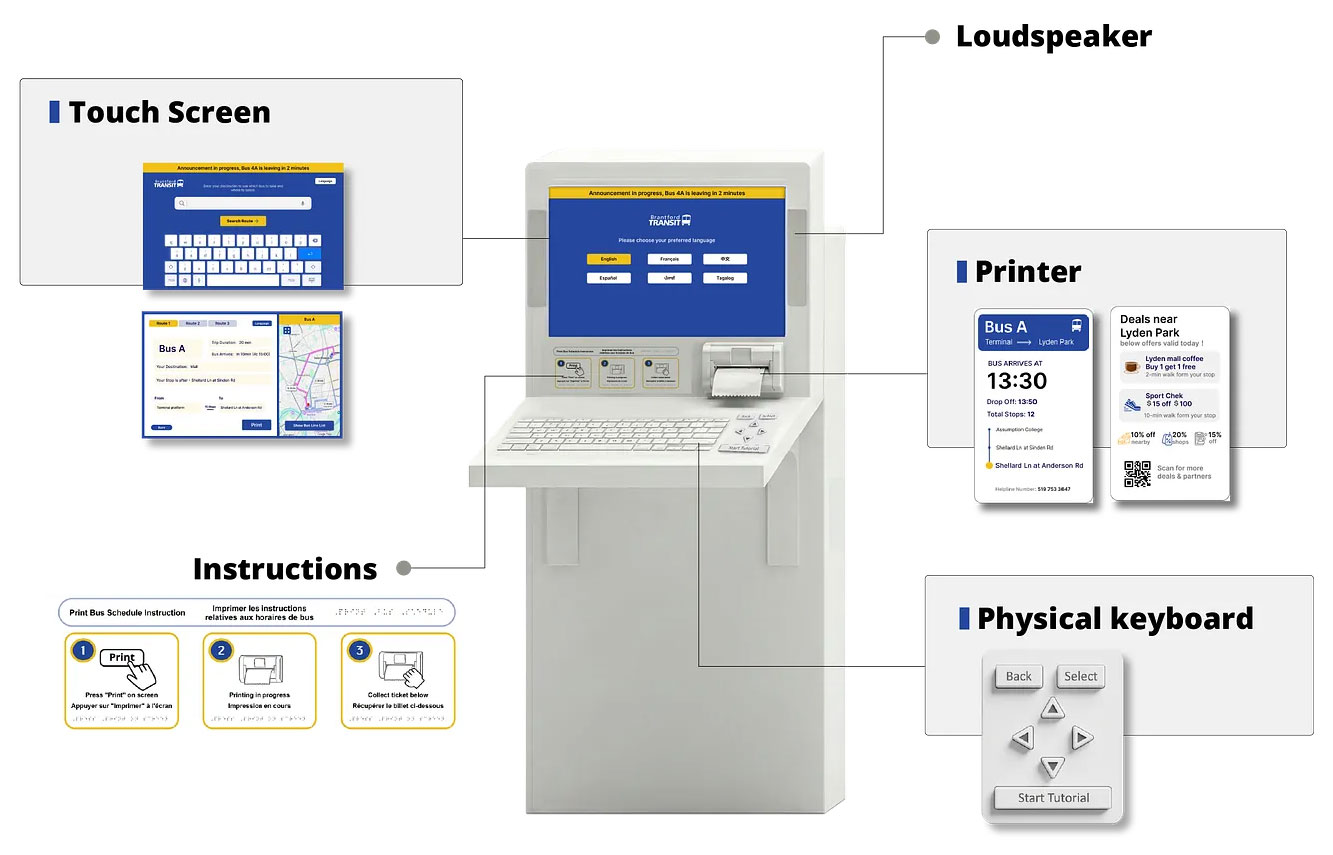
The team’s design for the Brantford Bus Information Kiosk.
In response, the team pursued a “phygital” solution: a bus information kiosk that combines both physical and digital elements to ensure accessibility for all. Users can interact with the kiosk via touchscreen or — as was the preference among older adults surveyed — a mechanical keyboard. At the end of the session, users have the option to print out an information card identifying which bus they’ll need to board, when and where it’s due to arrive, and a list of all the intervening stops before they should disembark. The screen itself is designed to raise and lower to accommodate wheelchair users, as well.
To address the language barrier, the team programmed the kiosk’s interface in Ontario’s most spoken languages.

“The response we got from the people testing the kiosk was really rewarding. They told us they were very happy with the design and that if it was installed in the terminal, they would definitely be using it.”
Yash Goswami, User Experience Design Master’s student
As much as Gogate enjoyed the research stage, which included a day at the bus terminal interviewing Brantford Transit riders and staff, she says her favourite part of the design process was building a life-size prototype of the kiosk. Before moving to Brantford from India, she’d gained experience as an industrial designer and relished the chance to flex those skills.
“We started building it in the common area of the Expositor residence, using cardboard boxes from Tim Horton’s and supplies from Dollar Tree,” says Gogate. “You have to get really creative when you’re building to scale in three dimensions, but it was important for us to see it at full size and then to put it into position at the bus terminal for testing.”
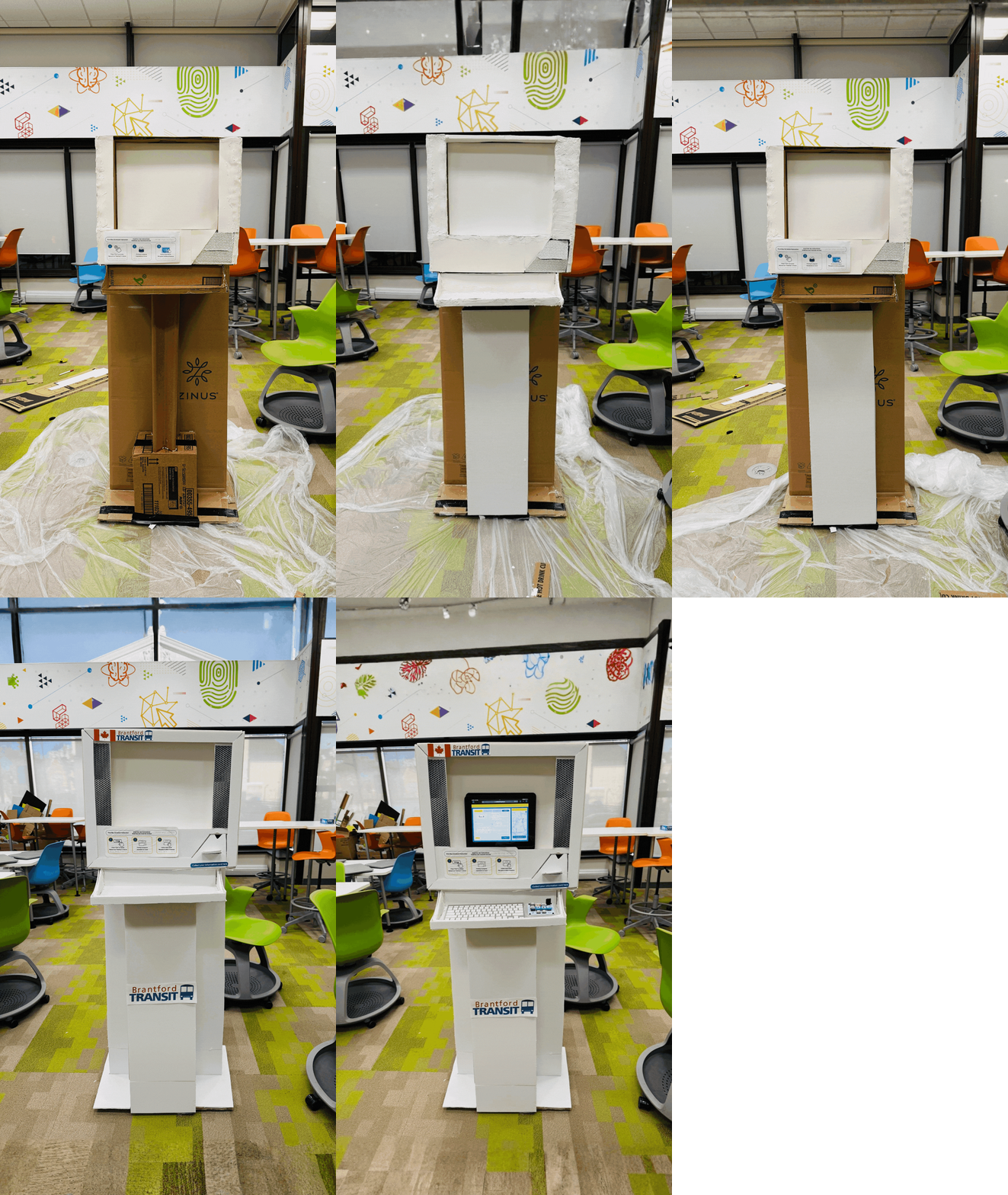
For Gogate, building the prototype of the kiosk was one of the highlights of the design process.
It was during the testing of this prototype that the team gathered information for final tweaks, including the addition of Braille to key buttons for visually impaired users, and the addition of a step-by-step tutorial for first-time users.
The on-site piloting also drove home the value of the team’s efforts.
“The response we got from the people testing the kiosk was really rewarding,” says Goswami. “They told us they were very happy with the design and that if it was installed in the terminal, they would definitely be using it.”
Throughout the design process, Muñoz provided invaluable feedback as a mentor.
“He encouraged us to keep thinking outside the box,” says Gogate. “When we first proposed a kiosk, he pushed us to take it further. As a designer, I learned it’s important to build something that not only solves the immediate problem but also addresses invisible disabilities like a lack of skills or access to technology.”
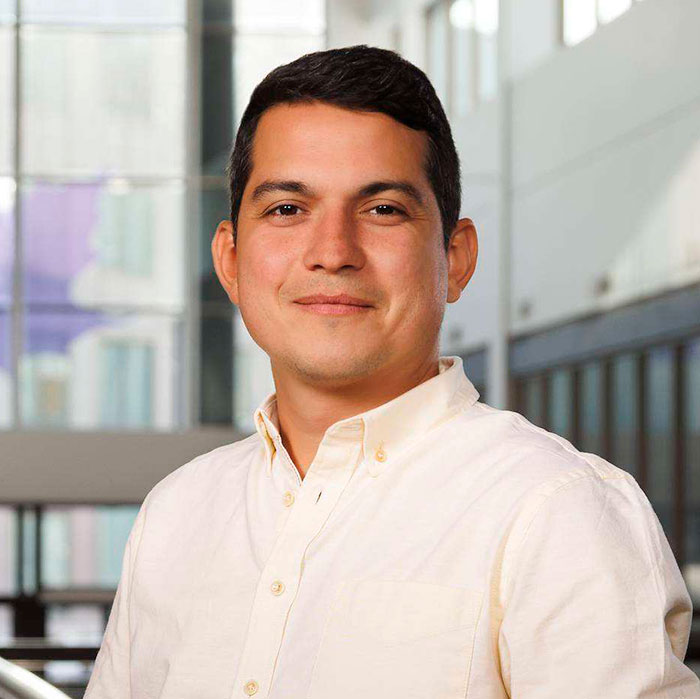
“Their project is an interesting exercise in how students in our User Experience Design program can tackle this community’s challenges and the issues they themselves face as residents of Brantford.”
John Muñoz, assistant professor in User Experience Design
For Muñoz, what set the design apart was the team’s dedication to accessibility, particularly the diverse needs tied to language and digital literacy.
“Their project is an interesting exercise in how students in our User Experience Design program can tackle this community’s challenges and the issues they themselves face as residents of Brantford,” says Muñoz. “Why this project really stands out is that it builds on the conventional bus terminal kiosk, adding features that will allow people with different capabilities to fully interact and get the information they need to get from point A to point B.”
“It sounds very simple, but is definitely not well implemented in most other cases.”
At the end of the term, the team members presented their design to Muñoz and Danette Dalton, executive director of the Workforce Planning Board of Grand Erie. Dalton was struck by the quality of the primary research the students had conducted.
“They spent a lot of time in the bus terminal talking to folks and collecting intelligence to design a thoughtful solution — and one that seems to be feasible in terms of implementation,” says Dalton. “Hopefully it’s something that city officials can consider as a way forward.”
In turn, Muñoz credits Dalton as being an ideal client for the students.
“Danette was very responsive, proactive and generous in providing valuable feedback. When students needed to collect data from particular sources, she was also incredibly helpful in opening some doors,” says Muñoz. “It’s a great example of how Laurier and local organizations can work together to develop solutions that will directly serve the community.”
Some of the issues identified through the students’ research have already begun to be addressed. Brantford Transit recently installed a screen displaying real-time bus information at the terminal, improving up-to-date service information for riders.
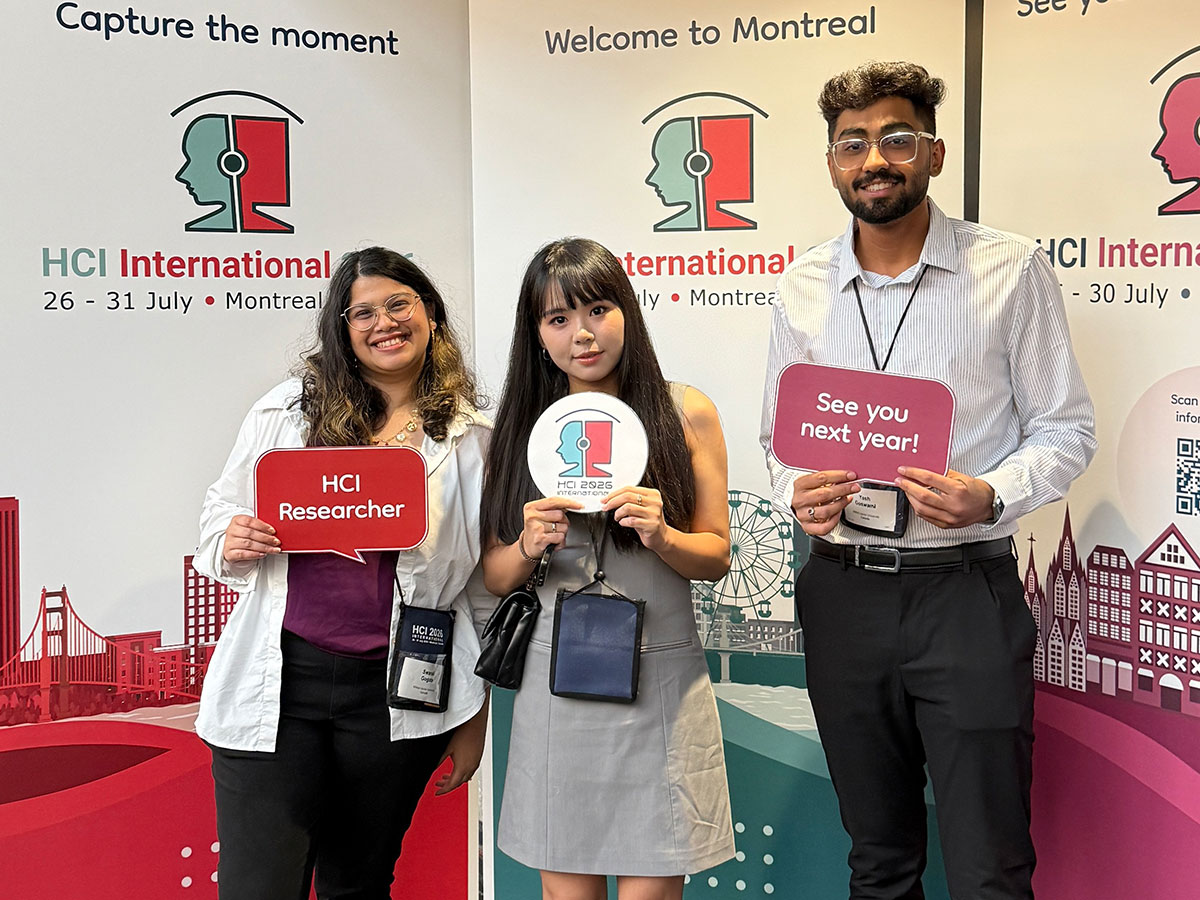
Gogate, Chen and Goswami attended the International Conference on Human-Computer Interaction in July.
With the coursework complete, Goswami turned his attention to the 28th International Conference on Human-Computer Interaction (HCI), held at the Montreal Convention Centre in July. Initially interested in attending the conference as a guest, he recognized that the team’s project was a strong fit for the conference’s HCI International Student Design Competition. Together with Gogate and Chen, he submitted “Brantford Bus Kiosk: Bridging the Digital Divide” for consideration. Selected as one of the 35 entries to advance to the final round of judging, the delegation from Laurier’s Brantford campus ultimately clinched third place.
“When I got the email telling us we’d won bronze, I was speechless,” says Goswami, who was joined by Gogate and Chen in Montreal to accept the award in person. “This conference is one of the biggest gatherings in the HCI world. Being recognized in the Student Design Competition among that crowd still feels a little surreal.”
“We are proud to have represented Canada and Laurier on that stage.”
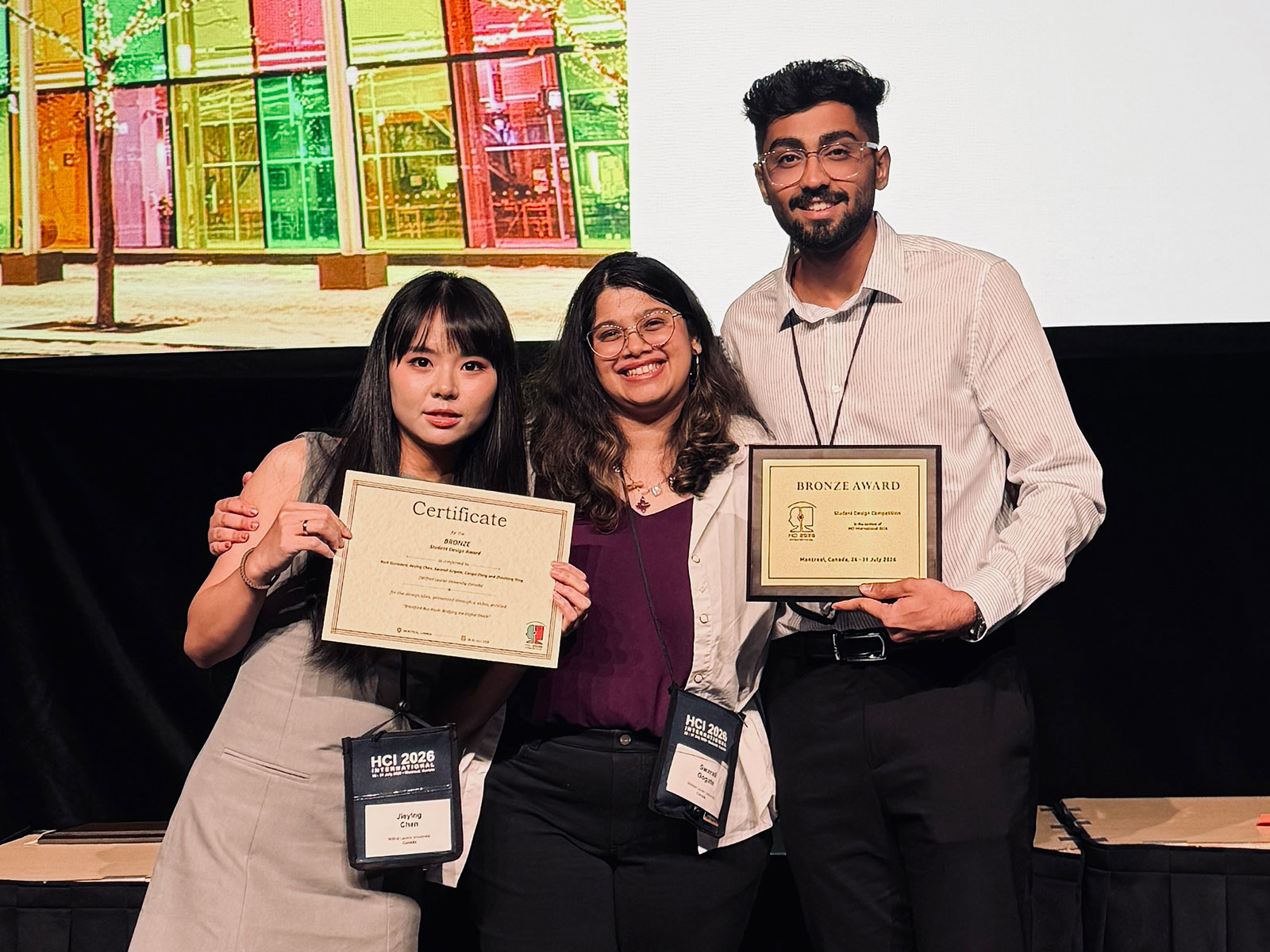
“It’s an amazing experience to have your name called to collect your award on stage,” says Gogate. “It was a very big deal for me.”
Dalton was thrilled to see the team’s design earn recognition beyond the classroom.
“It overjoys me to see students get these opportunities and thrive,” she says. “And hopefully, this sheds more light on their project and inspires local decision-makers to incorporate technology like this to help support the delivery of the city’s transit system.”
“Laurier’s User Experience Design students are in this program because they’re trying to make the world a better place. They should be at the table whenever we’re discussing solutions to the challenges we face as a society.”

Laurier’s Brantford campus is more than a place of learning — it’s a hub where campus and community come together. From student-led projects that strengthen local organizations to community lecture series and film screenings, Laurier is making a real impact in Brantford every day. Sign up for the Campus Connections Brantford e-newsletter to stay on top of upcoming events and inspiring stories.