

We use cookies on this site to enhance your experience.
By selecting “Accept” and continuing to use this website, you consent to the use of cookies.
March 13, 2026
Print | PDFWomen shaping the future of education took centre stage at the ninth annual International Women’s Day luncheon, hosted by the Wilfrid Laurier University Alumni Association and Waterloo chapter of the International Women’s Forum.
Held March 6 at Delta Hotels Waterloo, the event brought together more than 130 community members, alumni and sector leaders to explore this year’s theme: “Building Futures: Strengthening public education from kindergarten to university campus.”
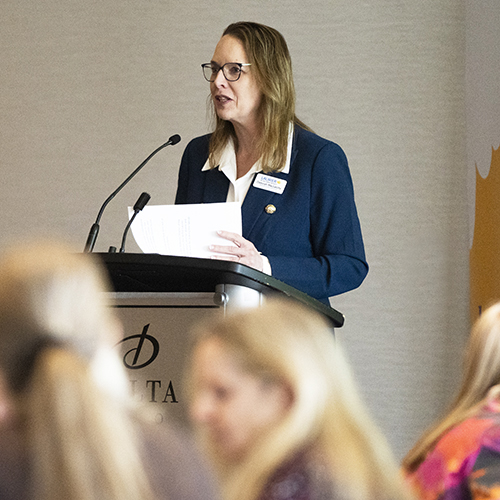
Laurier President and Vice-Chancellor Deborah MacLatchy opened the event with a keynote address, emphasizing the far-reaching impact of strong public education systems.
“When we invest in public education, we see improved population health, an increase in civic participation, economic growth, and prosperity, all of which are foundational to enabling individuals and communities to thrive,” said MacLatchy.
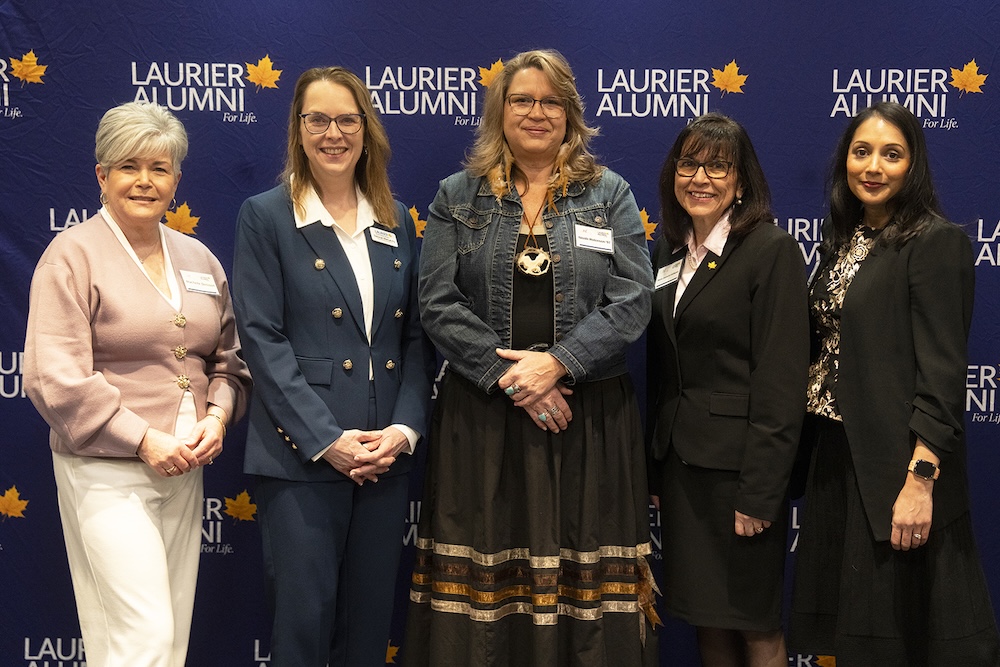
Machelle Denison, chief executive officer of Strong Start; Laurier President and Vice-Chancellor Deborah MacLatchy; Nicole Robinson, equity and inclusion officer – Indigenous focus at the Waterloo Region District School Board; Maria Cantalini-Williams, dean of Laurier’s Faculty of Education; and Ami Shah, chief executive officer and co-founder of Peekapak, at the ninth annual International Women’s Day luncheon.
MacLatchy highlighted the work of Laurier faculty, students, staff and alumni who are strengthening education. She noted that 91 per cent of Laurier Bachelor of Education alumni who graduated between 2021 and 2023 are teaching in school boards across Ontario, with 85 per cent doing so within 100 kilometres of Laurier’s Brantford and Waterloo campuses.
Additionally, MacLatchy highlighted Laurier’s Centre for Leading Research in Education, where faculty are advancing research that informs evidence-based teaching and learning practices, as well as the Laurier History Teachers’ Conference, which has connected local educators and faculty for collaboration and knowledge sharing since 1971.
“Education remains one of the most powerful drivers of opportunity and empowerment,” MacLatchy said. “It has long been, and continues to be, fundamental to opening doors and creating pathways to independence and leadership.”
Following the keynote, Machelle Denison, chief executive officer of children’s literacy charity Strong Start and a member of the Waterloo chapter of the International Women’s Forum, moderated a panel discussion featuring leaders working to address evolving educational needs in their communities.
“Education remains one of the most powerful drivers of opportunity and empowerment.” – Laurier President and Vice-Chancellor Deborah MacLatchy
Panelist Nicole Robinson (MSW ’07), equity and inclusion officer – Indigenous focus at the Waterloo Region District School Board (WRDSB), works to increase Indigenous awareness within educational systems by building meaningful relationships between WRDSB staff, students and Indigenous communities in the region. Robinson opened the discussion by emphasizing the importance of relationship building and reconnecting with the land.
“Reciprocal relationships with Indigenous communities are essential in education,” she said. “When we imagine a strengthened system, we see more Indigenous teachers teaching students Indigenous material. We also need to legitimize land-based learning because the quality of education that comes from learning on, from and with the land is fundamentally where we can grow as a society.”
Panelist Maria Cantalini-Williams, dean of Laurier’s Faculty of Education, has led large-scale research initiatives focused on innovative teacher education models and community engagement in schools. She has worked as a teacher and curriculum consultant in various school boards and applied that experience to her roles in post-secondary education.
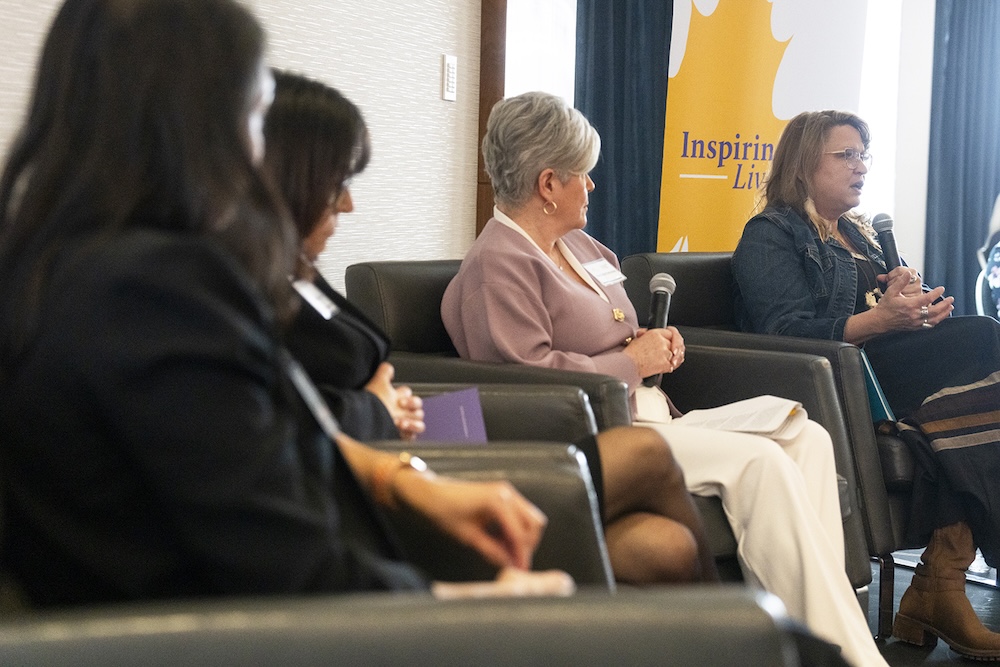
Panelists engage in discussion during the ninth annual International Women’s Day luncheon hosted by the Wilfrid Laurier University Alumni Association and Waterloo chapter of the International Women’s Forum.
During the panel discussion, she noted the importance of supporting future and current teachers as the profession evolves.
“Laurier is fortunate to be welcoming approximately 420 Bachelor of Education students next academic year with funding from the province,” said Cantalini-Williams.
When asked about retention of teachers, she stated, “It’s important that we value teachers as ‘frontline workers’ who have immense responsibilities and who make a lifelong impact on students. Teachers need professional autonomy, ongoing development, safety, resources, and recognition to stay in the profession.”
Cantalini-Williams also noted that interaction, integration and innovation are essential to strengthening education. She discussed the need for physical and virtual spaces where educators, students and community partners can share ideas, stronger support for smooth transitions across education levels, and the value of expanding work‑integrated learning opportunities. She added that fostering an innovation mindset and exploring a national focus on education could help align and enhance systems across the country.
Panelist Ami Shah (BBA ’04), chief executive officer and co-founder of the award-winning social-emotional learning platform Peekapak, brought a global perspective to the discussion.
“Around the world, our research shows that when social and emotional skills are intentionally taught and supported, students outperform their peers, but there’s rarely enough time,” said Shah. “Academic instruction is such a strong priority that these essential skills often fall to the side.”
Shah also stressed that supporting student development must begin with supporting educators.
“It’s important for teachers to understand where their students are coming from and how to support them,” she said. “But it’s equally important that teachers receive professional development, so they feel confident teaching these skills.”