




We use cookies on this site to enhance your experience.
By selecting “Accept” and continuing to use this website, you consent to the use of cookies.
June 9, 2026
Print | PDFStory and interview by Patricia Goff, Associate Dean of Arts: External
Tim Donais hadn’t planned on being a professor. In fact, his first degree was in journalism with a political science minor. Only later would his interest in politics resurface and become the focus of his post-graduate studies and, ultimately, his career.
After completing his BA, Donais took a job with the United Nations Association in Canada (UNAC). There he found himself in the thick of some of the most significant political developments of the 1990s. It was an extraordinary time to have a public-facing role in international affairs. The Rwandan genocide was unfolding. The former Yugoslavia was breaking apart. At the United Nations, Secretary General Boutros Boutros-Ghali had tabled the landmark Agenda for Peace report, sparking a conversation about the legacy of peacekeeping, conflict prevention, and post-conflict peacebuilding.
Donais found himself organizing seminars and public discussions on the UN’s role in these events, as well as Canada’s possible contribution. In the process, the political questions that had interested him in his undergraduate studies resurfaced, this time with a greater sense of urgency and real-world relevance.
Motivated by these questions, Donais decided to return to school to earn his master’s degree in political science at York University. The summer before he did so, he was recruited to be a United Nations Volunteer in Bosnia, an experience that proved to be transformative.
“It changed everything,” says Donais.
He had never seen such a place. Arriving in Sarajevo aboard a Canadian Forces Hercules aircraft, after having helped supervise voting by Bosnian refugees in neighbouring Croatia, Donais was met by the devastation of war. Buildings and communities lay in ruins. The experience opened his eyes to the human cost and the policy complexities behind the conflicts that he had studied. He wanted to help.
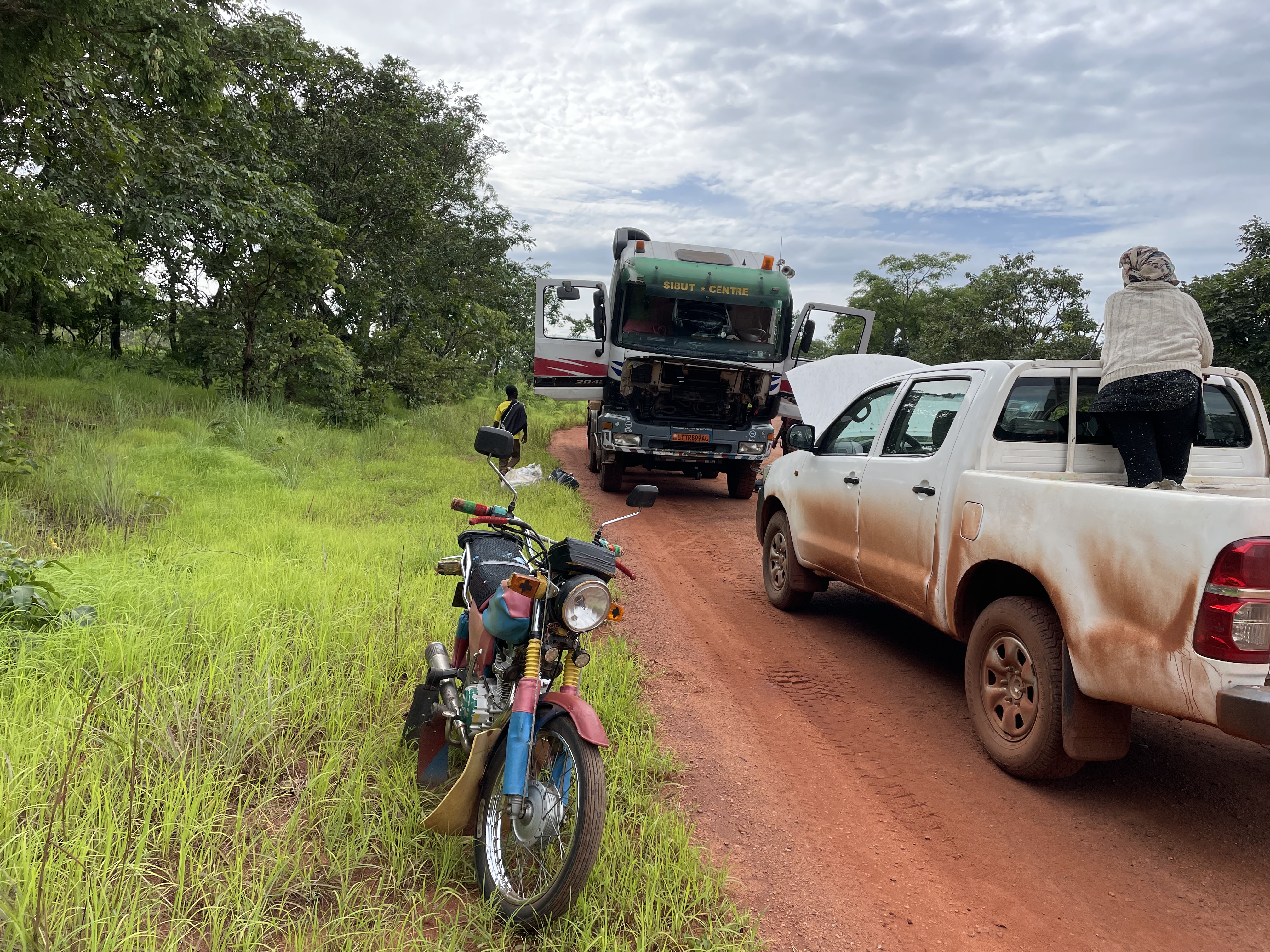 Car trouble en route to Bouar, CAR
Donais’ volunteer position evolved into a job. Throughout the late 1990s, he held a number of contracts with the Organization for Security and Co-operation in Europe (OSCE), working on elections issues, human rights initiatives, and democratization projects. Along the way, he served as a media affairs officer, a web editor, and a speechwriter for the OSCE ambassador. He even had the chance to announce Bosnian election results on national television on one occasion!
These experiences were formative. After completing his MA, he moved on to his PhD and studying Bosnia became the natural focus of his research. He started to ask the questions that have shaped his academic career: How can societies rebuild after conflict? How can civilians be protected during and after periods of conflict? What is the most effective design for security institutions?
These questions remain foundational to his decades-long research program. Donais has authored three books, two co-edited volumes, as well as many articles and book chapters, establishing him as a leading figure in debates about post-conflict peacebuilding, civilian protection, and security sector reform.
His most recent book, Peacekeeping and the Protection of Civilians: From Moral Imperative to Effective Practice (Routledge Press, 2025), has allowed him to step back and assess how international civilian protection approaches have evolved over time. The idea for this recent book came to him during a travel course that he led for Laurier students to Bosnia and Croatia. They visited Srebrenica, the site of such extraordinary suffering in the mid-1990s, in particular the massacre of over 8000 Bosnian Muslim men and boys despite the city having been designated as a UN “Safe Area.”
The visit was deeply emotional for the students. It also prompted reflection for Donais as he was reminded that the UN had tried to protect civilians there but failed. To its credit, Donais points out, the UN did rethink its civilian protection efforts following some high-profile failures like Srebrenica. Donais’ 2025 book takes stock of these changes to assess what has been learned and what has changed on the ground for civilians. Through a thorough examination of three case studies - UNMISS in South Sudan, MONUSCO in the Democratic Republic of the Congo and MINUSCA in the Central Republic – Donais examines why UN peacekeepers struggle to protect civilian populations. He finds that the notion of civilian protection is still a contested concept. There is no consensus on who should be protected or how protection should be operationalized. He also argues that there is often a wide gap between the protection mandate handed down by the UN Security Council and the availability of resources to implement the mandate on the ground.
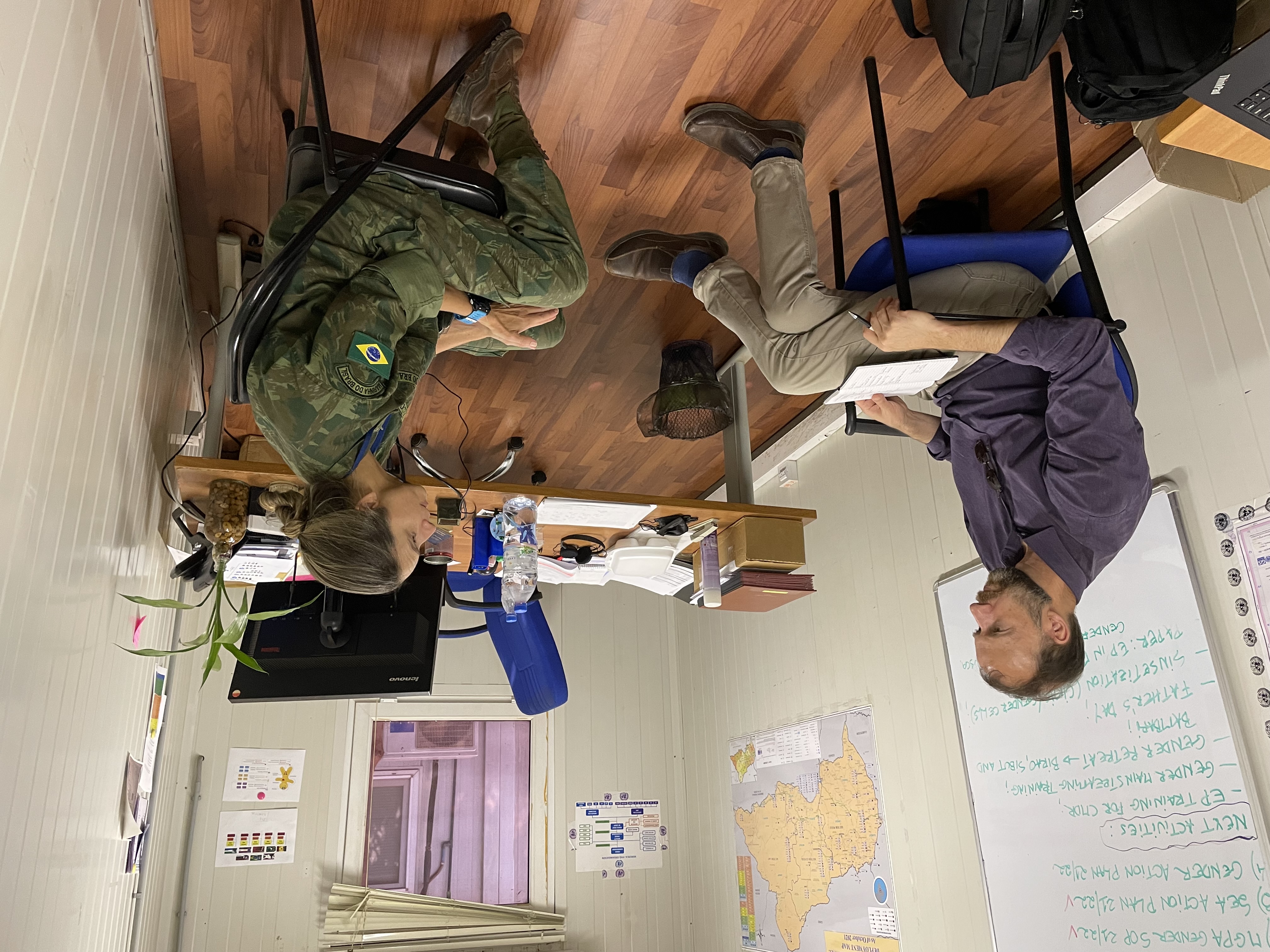
Fieldwork remains central to Donais’ scholarship. His research has taken him back to Bosnia many times, amounting to nearly two years spent in the country, as well as to South Sudan several times, the Central African Republic, Haiti, Afghanistan, and other regions grappling with the aftermath of conflict.
Donais believes that his academic endeavours have been enhanced by the fact that he was able to spend time in the field as a practitioner before becoming an academic. He says his work with UNAC and OSCE ultimately complement what he does as a professor and researcher. Experience in the field, he says, gave him the confidence to question some of the assumptions embedded in academic theories and policy frameworks. At the same time, witnessing conflict and its aftermath firsthand can leave one with a heightened sense of cynicism. Many of the conflicts that he first encountered in the 1990s remain unresolved. For Donais, it was a welcome change to move into academia. Scholarship became a way to explain and understand what he had observed in the field.
It is perennially difficult to gauge the impact of academic work, particularly in a field like Donais’ where international organizations and governments play the lead role in devising policy. Some of his early work contributed to the so-called “local turn” in debates about post-conflict peacebuilding, the idea that local communities should drive the implementation of post-conflict reconstruction efforts rather than simply being on the receiving end of externally devised solutions.
More recently, Donais has examined the impact of academic ideas with a more critical eye. In a co-authored article with one of his graduate students, he argues that academic concepts and arguments do not always find their way into practitioner debates unchanged. Instead, policymakers and practitioners can adapt, reinterpret, or selectively adopt concepts to suit their own institutional contexts and interests.
The interplay between research and practice is also evident in Donais’ teaching. Whether he is leading a travel course or on campus in Waterloo, Donais draws on his practitioner experiences to bring the material to life. He presents students with scenarios based on real-world dilemmas faced by diplomats, peacekeepers, humanitarian workers, and government officials. These exercises challenge students to confront the difficult ethical and moral questions that accompany efforts to protect civilians in conflict zones.
 In the air on the way back to Juba from Bentiu, South Sudan
It’s not an especially hopeful time to be a security scholar. As Donais observes, “we are witnessing in real time the unraveling of the institutions of global security governance that have been in place since World War II.” The resulting uncertainty can be both disorienting and discouraging. Yet Donais sees an opportunity. His latest research project will help to make sense of this shifting landscape. As we watch the marginalization of the UN as the main security actor, Donais has a hunch that regional organizations might fill the vacuum. He plans to find out. Focusing on the Caribbean Community (CARICOM), the Southern African Development Community (SADC), and the Association of Southeast Asian Nations (ASEAN), the project will examine if and how they have modified their efforts as the UN’s prominence recedes.
This project offers hope that, as the foundations of the postwar order shift, this process of transformation will give rise to new institutions that can carry forward the important work that was started decades ago.