
User Experience Design: More than Usability
Wilfrid Laurier University's Bachelor of Design in User Experience (UX) is a four-year comprehensive degree program – the first of its kind in Canada. UX designers seek to create something new for the world by combining creativity, strategic design-thinking, user research and social awareness.
Students gain the intellectual tools to think critically about the world, and understand how cultural, societal, economic, political and environmental factors contribute to users’ experiences. Students are exposed to the impact that good design has in tech, not-for-profit, government and public sectors. Students work in teams to solve design challenges while contributing to social justice, community building and corporate goals.
Designing a Better World, One Experience at a Time
Throughout the program, students have opportunities to interact with clients across industries through experiential and work-integrated learning. Students are mentored by industry partners and complete industry projects that reflect real challenges and opportunities in the way humans interact with technology. Students may apply to Co-op at the beginning of their third year of study.
Get Involved with the UX Design Program
Our program depends on real-world, experiential learning as we connect students to the real world of work. The UX Design program has several options for partners to get involved, with both no-cost and for-a-fee opportunities.
Bring Your Challenges to Our Classroom
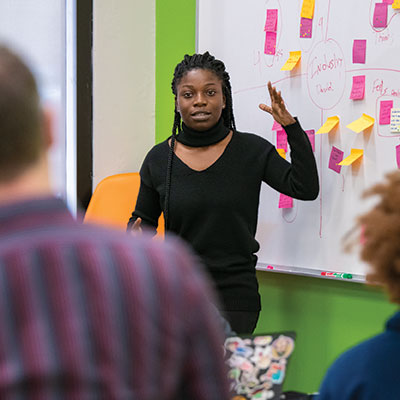
To reinforce pedagogy based on discovery and inquiry, we encourage our clients to partner with faculty in our classrooms on real projects. Over a full term (12 weeks), our students will work through your challenge and come up with creative solutions for a product, service or space.
Career Readiness
Help our students meet their career goals. We host cover letter, resume, interview preparation sessions and workshops. We also host portfolio review sessions.
Co-operative Education
Students compete for admission to co-op, and successful candidates apply for jobs in third year and begin their co-op work term after third year. The extended work term of 12-16 months allows each student to engage in a project of reasonable complexity and see it to completion. Recruitment for UX students begins in December for work terms beginning in May.
Usability Testing
Our students are available to run usability testing and other UX services for a fee. This is a great option for partners who know how important UX is for a high-impact product/service, and are looking for creative solutions at a reasonable cost.
Be a Guest Speaker
We are always coordinating guest speakers from various areas of the UX industry to meet with our students in the classroom, on panels or at other events.
Sprint with Us
Our Brantford campus is a perfect option for design jams and hackathons, face-to-face or virtually. Have a challenge that needs lots of creative minds to explore? Connect with us!
Get Involved with our Development
Our program is growing, and it’s growing quickly. Learn how you can get involved philanthropically with our UX Design program, and contribute to the success of your future designers.
Courses in the UX Program
- Design Thinking I and II
- Designing for Equity, Diversity and Inclusion
- UX Strategy
- UX Research
- Information Design
- Interaction Design
- Design of Immersive Spaces,
- Mobile App Design
- Maker Lab I and II
- Digital Technology Lab
- Web Design I and II
- Special Topics in UX
- Graphic Studio Design I, II and III
- Fourth-Year Capstone Project
Sponsor an In-Class Project
Building on our curriculum, students work in teams tackling real-world problems that exist in industry, not-for-profit, government and the public sector.
Starting with stakeholder empathy as a key tenet, students move through a full cycle of horizon scanning, problem discovery, user research, solution finding, solution evaluation and communication techniques.
Working with and for actual clients, students progress through seven weeklong agile design cycles, culminating in an interactive prototype that is only a few steps removed from a minimal viable product.
What We Need From You
- Bring in your unsolved challenges or problems to our classroom and support a team of 4–6 creative students in helping to develop a solution.
- We need a one-page project proposal outlining: project overview, objectives, components, project vision, stakeholders, and the value to the students. Be as specific and concrete about the challenge as possible.
- Projects can come from postsecondary institutions, faculty, industry associations, community organizations, corporations (large and small), corporate labs, start-ups and government agencies.
- Industry project sponsors are invited to a mandatory in- class “pitch” session, where sponsors pitch their projects to the class.
- At the first meeting, a timeline is agreed upon between the project sponsor, student team and instructor. Students assign roles and responsibilities and begin work.
- Student teams communicate once a week with the industry partner virtually with a pre-arranged agenda. One student is assigned as the communication lead.
- Weeks 6–11 will be spent in agile sprint design and development.
- Final in-class presentations occur last week of class.
- It is mandatory for project partners and their guests to attend in person or virtually.
- A final project presentation and/or Word document is required from students for industry partners.
- A final project evaluation is required from the industry partner by completing a project rubric to assist with grade assignment.
- Non-disclosure agreements (NDAs) are available.
Capstone students were challenged with seeking a solution to increase awareness and engagement with their “Workplace Strategies for Mental Health (WSMH)” website. By increasing awareness and engagement with HR Professionals, Canada Life hopes to support the burden of mental health for it’s clients. Through usability testing the team designed an onboarding experience.
Students were asked to explore ways to provide a digital product team with opportunities to virtually co-locate to better facilitate activities like white boarding sessions, stakeholder workshops, group or one-on-one coffee chats, water cooler and kitchen conversations that usually take place in person.
“Flex,” an easy to understand dashboard, was designed to facilitate productivity and social interactions including formal and informal meetings, random and candid conversations and the ability to signal the start and end of the employee’s work day.
Students applied human-centred design in attempting to solve the issue of systematic inequality in the hiring of co-op students within the ODS Lab. With a service design lens the students conducted user research, created personas, a journey map and developed a service design blueprint tackling the ODS co-op hiring process and outreach.
Students designed and built an app called “Bookable” for Europro, a client of Focus21. Europro is a property investment, management and leasing company headquartered out of Toronto and needed an app to help co-shape the future of their leasing spaces.
Students designed the Rink Report App to help the City of Brantford support the many volunteers who maintain the neighborhood ice rinks.
Students were tasked with creating a “Citizen Account Portal” that allows citizens/residents to manage and track all interactions with the region.
The students worked on solutions to reinvent and disrupt the restaurant industry. Through research, ideation, prototyping and testing, they delivered a variety of persuasive solutions which included service design and mobile applications.
Students worked on projects aligned with Unicef Canada, specifically child-led advocacy that teaches kids how to take action and design deliberate change around an issue or problem they care about:
- Students were tasked with designing an online event for National Day of the Child. The solution was a unique online experience that is intended to inspire children to learn about Unicef and how it can advocate for them.
- Students tackled “Preparing the Voices of Tomorrow,” a project aimed at youth and voting. They designed a framework for grades 1–12 to help create an awareness around voting and the power it can have.
Students conducted focused market research, competitive analysis and applied design thinking methodology to develop a creative digital solution strategy to engage a specific target market.
Students worked on two projects:
- A redesign of the user interface based on new feedback/data collected during recent usability testing.
- A new design to support secondary school outreach based on government policies.